We had pre-booked all of our reservations through our stay in Chiloé, including the car rental for this last week. We didn’t book any lodging after Chiloé, though,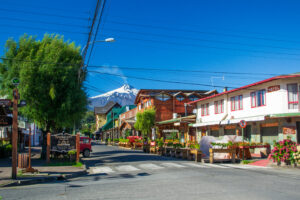 because other than driving through the Lake District, we weren’t exactly sure where we wanted to go. The grand idea was to zig-zag our way back and forth across the Chilean/Argentinian border as fancy moved us.
Romantic idea, but we couldn’t get the necessary paperwork and insurance to cross the border with the car. We spent some time trying to make this happen, but ultimately had to resign ourselves to staying within Chile this visit. Bariloche is so close, but as we missed it last year, we will miss it this year, too. Like Scarlett O’Hara, we consoled ourselves with thoughts of “another day”.
The Lake District, some 550 miles south of Santiago, is rimmed with volcanoes and dotted with dozens of beautiful, deep-blue lakes formed eons ago by glaciers. Looking in any direction is to behold truly spectacular scenery, not unlike Switzerland except for the smoke rising from the volcanoes and the green parrots that squawk overhead. Green pastures populated with cattle and sheep dot the landscape alongside picturesque farm houses and barns. Rivers and waterfalls are abundant.
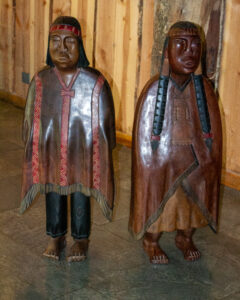
This area was home to the fiercely independent Mapuche Indians, who, because of its isolation, managed to avoid conquest by both the Inca and the Spanish. It wasn’t until Chile won its independence in the early 1800’s, and the newly formed government encouraged German immigrants to move into the area, that the Mapuche were subdued. This region essentially became the German heartland of South America in the mid to late 1800’s as Germans sought to escape the hardships of Europe. After WWII, there was another influx of German immigration. Oddly, though, during the brutal Pinochet years, Germans left in droves to emigrate back to East Germany.
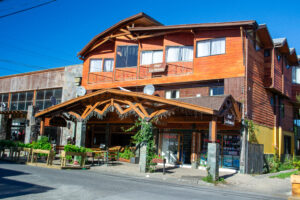 If you tune out the Spanish all around and focus on the architecture, you would think you were somewhere in the
 Swiss-German Alps. A-frame roofs with smoke curling out the chimneys, brightly colored houses with wooden, scalloped shingles, and flower boxes adorn the buildings. Yet many of the place names are Mapuche. It all combines to give this area of Chile a very distinctive yet discordant ambiance.
The Chilean population, in general, is largely mestizo—descended from mixed Spanish and indigenous, with a little German thrown in here and there. I am tall here, often standing a few inches above the women and at equal height to many of the men. Chileans seem to be suffering from the same ailment as we Americans: super-sized portions resulting in super-sized bodies. Kevin and I long ago figured out that we needed to share single plates when ordering food.
After leaving Chiloé, we picked up our car (a very reasonable VW this time) at the Puerto Montt airport and drove to Puerto Varas, the gateway to the Lake District. We spent a night there getting ourselves organized for the next week. One of our first tasks was to find a road map. Figuring we could buy a map once we were here, we left home without one. Silly us!
Like our attempt to get insurance papers for the car, each store or office we visited either told us, “No, we don’t have one, but the shop on the corner does”. Or, they pulled out the same photocopy of a map of the southern half of Chile. Imagine trying to figure out the back roads through Yosemite with a map of CA. Eventually, we paid 20 bucks for a book with some area maps. Armed with that and a half dozen of the same useless country maps, we headed out.
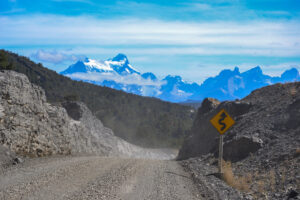 Every drive we have taken here in Chile starts on a well-maintained, paved highway that, shortly out of whatever town we are leaving, becomes a less well-maintained, two-lane country road. The pavement generally doesn’t last long, though, and soon turns to a pot-holed gravel road. Just as we tire of negotiating the potholes, the road becomes one lane, making driving even more tiresome. What is absolutely confounding is when we think we are lost and that the road we are following cannot possibly be the road to anywhere, a yellow highway sign appears, cautioning us that a curve is just ahead. Directional signs seem to be plentiful until we need them. More than once, we have come to a crossroads with no sign whatsoever, only to take the wrong turn and have to backtrack.
On the drive to Huilo-Huilo, convinced we were lost on some backcountry road to nowhere, we stopped to ask an old man walking along if we were on the right road to Cruceros, the next town on the map. We knew we had to be within 7 to 10 miles, as we had been driving for a long time. We were hoping that the simple question, “Buenos dias Señor, is this the road to Cruceros?” would yield a simple “Si, claro” and we’d be on our way.
Y Puede Ser Que No
Instead, the gentleman leaned on the open car window to explain in Spanish that to reach Cruceros, we needed first to follow the road as it curved to the left, then continue until it curved to the right and then follow it over the hill, but not the big hill, and then continue down through the dip in the road, but to watch out for the cows and then ….. After a good ten minutes, he finished with a definitive, “Yes, this is the road.” A collective sigh of relief emanated from both of us.
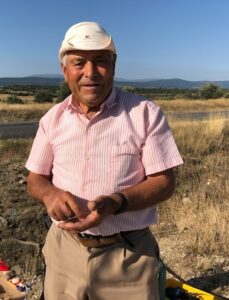 To be polite and respectful and not just zoom off, leaving the man in the dust, Kevin asked a clarifying question. I held my breath as the man leaned even further into the car. I thought for a moment he was going to climb into my lap. While he again explained to Kevin how to get to Cruceros (follow the road as curves to the …), I had a good view of his dental work—lots of metal among some seriously missing teeth.
With the gentleman holding my hand, we made our goodbyes. In parting, he said in Spanish, “It is so odd that you just appeared here. I probably will never see you again.” A heavy moment in a casual encounter. To lighten the mood, Kevin said, “Puede ser que sí” or “You never know”. With a smile, the gentleman replied, “Y puede ser que no” or “Probably not”, and we drove off.
While life is long and strange, the old man is probably infinitely wiser than we are and is most likely right.