As often as we have done this now, it still amazes me that you can book an entire trip to someplace far, far away, pay a bunch of money, then show up on the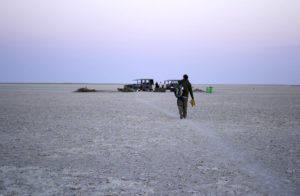 designated day, at the designated time and place, and there is someone friendly there to meet you. And, he has your name on his piece of paper!
 Tuesday, we arrived at the Maun airport as directed, and sure enough, a gentleman from the chartered flight company met us, handed us our tickets, and escorted us to our little 6-seater plane out on the tarmac. Within a few short minutes, we were in the air flying southeast out of Maun over the Okavanga Delta towards the Makadikadi Salt Pans and the Kalahari Safari Camp. The land empties as you approach the salt pan, an enormous fossilized lake bed that stretches 180 degrees in front of you. Beyond that is the Kalahari Desert.
Landing on the rough, dirt, bush landing strip, the camp staff were there to greet us. A short drive through the bush, and we met two elephants that had been hanging around the camp lately. We were not prepared for any large animals, given the time of year, but because there was so much rain during the last rainy season, there was still enough for them to eat. We saw small herds of zebra and wildebeest, a jackal, and at least a half dozen bird species. And we hadn’t even been out on a game drive yet.
Once settled into our amazing tent rooms, we sat down with the other 10 guests for a lunch of fresh vegetables on a light pastry shell and a bed of couscous. 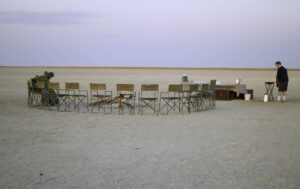 Fresh lemonade, homemade cookies, and an open bar. What’s not to love?
One of the big attractions here is traveling out onto the pans. To do that, we mounted Quads, two to each one, and followed our guide for an hour out onto the pans. Otherworldly is the only worthy description. The pans are flat in every direction, with nothing but sand stretching out into the horizon in all directions.
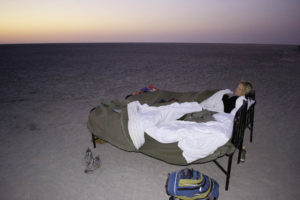
At twilight, drinks were served around a campfire, we ate dinner at a candlelit, white table-clothed dining table, and then we were escorted to bed! Yes, unbeknownst to us, they had made beds for each one of us out on the pan, under the stars. Like a Dali painting, we were all lined up in our metal beds, equally spaced from one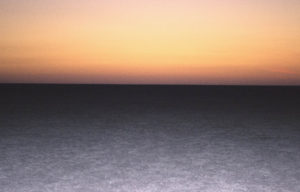 another and pointing to the east—perfectly positioned for the rising sun the next morning. As we climbed into bed, giggling like little kids on our first camping trip, we were delighted to find hot water bottles tucked under our covers to keep us cozy all night.
Rarely does one get a view of the night sky and the glorious Milky Way without any light pollution. Bone tired, yet it was too beautiful to give in to sleep. We lay there in awe, looking at the stars above and what this day had brought us. The next morning’s sunrise was the icing on the cake.
During the Peace Corps, Scott and I did a self-driving safari and camped on the edge of the dry Makadikadi pan. During the dry season, there is nothing but miles and miles of dried mud. During the rainy season, however, elephants travel deep into the pans to eat the grasses that grow there. I still have a palm nut I picked up that was lying in the dry mud. Yet there are no palm trees on the pan. An elephant must have eaten from a palm tree before entering the pans and pooped!