Years ago, when Scott, my ex-husband, and I traveled throughout Southern Africa, we usually did it on the cheap. We were Peace Corps Volunteers, and it 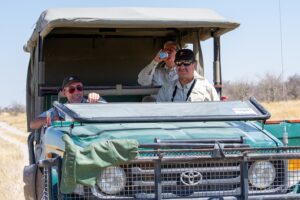 was a matter of pride, a badge of honor to “rough it”. If you didn’t have a few dicy travel stories to tell when you got together with the other volunteers, then you really had no respect. We’d buy guidebooks, of course, and, curious, we read up on where we were going, but there was no internet, and we certainly didn’t hire guides.
This time we have guides with us all the time—great guides! They drive us, take us for walks, keep us from doing stupid things, and steer our boats through the hundreds of delta channels. Moreover, they eat with us for all meals and have cocktails around the bar in the evening. These folks have some stories!
 They also work hard. They are on 24/7 for up to three months at a time, then get 14 to 21 days holiday, then back to work. Guests come and go every few days, and they have to be friendly and cheerful. Moreover, they have to treat each guest as the most special guest they have ever had. The job description probably reads something like, “Must love interacting with strangers who haven’t a clue about anything, and you must keep them from being eaten, all the while making them feel very special.” Clearly, this is not a job for me. I hate people I don’t know, and am not known for my patience. I could answer a job description like, “Are you a curmudgeon? Hate people? Then we have the job for you!”
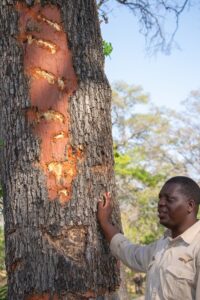
As we were out walking with Mots, our Motswana guide here in the Delta, I realized how much we missed years ago by doing self-guided safaris. Mots, like our Belgian guide, Bart at Camp Kalahari, is a walking encyclopedia. Scott and I blithely walked over lion tracks, missed that the wet spot on the path of a hyena marking his territory, couldn’t tell that the rubbings on a tree were that of a warthog and not a hippo or an elephant, and weren’t able to decipher the different bird calls—we generally wandered cluelessly through the wilderness. We didn’t know about wild sage or sweet lavender, or their medicinal uses. Forget spotting any animal that didn’t practically jump out in front of us. All of our guides here can spot animals far off in the distance and can identify birds from their flight patterns and calls.
Bart, a Belgian, has been in Botswana for 30 years. He has two Master’s degrees in wildlife, something or other, and worked on various wildlife conservation programs for the government before becoming a guide. Married to a Motswana with children enrolled in village government schools, he has a unique perspective.
Mots, or Motswani, refers to himself as a River Bushman who grew up with a semi-nomadic family on the edge of the Kalahari Desert. His grandfather was a true hunter-gatherer. Walking with him in the bush provided compelling depth to a seemingly flat landscape. What was one-dimensional became a rich tapestry of interwoven connectivity. We stopped to examine droppings from dozens of animals, made sure we moved in the opposite direction of the new lion tracks, read the various animal markings on trees, and stopped to smell the plants around us. It was like being given the gift of sight after a life in darkness.
And as Kevin summed it up well as we were digging through yet another pile of animal poop, “These guys do indeed know their shit!”