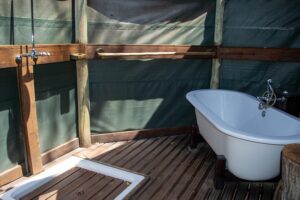
 There is nothing quite like bathing in an outdoor shower and then sitting on your deck in your fluffy towel, watching elephants fifty yards out as they feed and cool themselves in the waters of the Okavango Delta.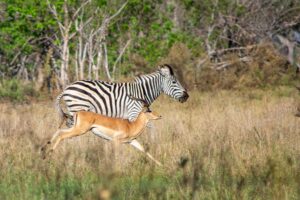
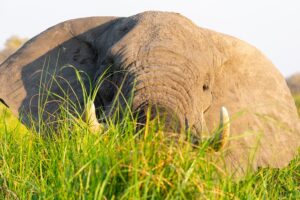
We sat and watched the infamous Little Dave, an elephant known for trouble-making, for a few hours one morning. We were so close that we could hear him as he pulled the grass up with his trunk and slapped it back and forth to remove the mud. His ears constantly moved forward and back to cool him. Every few minutes, he stopped long enough to spray himself with water. His stomach gurgled constantly. Once in a while, Little Dave let out a deep moan or a snort. An egret rested peacefully on his back.
We arrived here at Gunns Camp on F afternoon after flying from Camp Kalahari and landing on yet another bush airstrip. Pilots always circle these short landing strips to ensure there are no animals about. When we flew out of Camp Kalahari yesterday, three elephants stepped out onto the runway. Fortunately, they were on their way over to the Mopane trees on the other side. Otherwise, we would have had to send someone down there to shoo them away.
 The Okavango Delta is as watery a world as the salt pans are dry during the dry season. Yet, it took only 90 minutes of flying time to get here. Life in the pans
 is harsh and tenuous. Here, in the Delta, it is abundant and seemingly kinder.
Gunns Camp, at the end of Chef’s Island in the Delta, is situated on the edge of a main channel with thick marsh leading up to the actual camp. Luxury tents line the perimeter with a central three-story thatch lodge a quarter-mile away. A winding, elevated boardwalk connects the tents and lodge. At two points, there are signs for elephant crossings. The camp staff has lowered and narrowed the boardwalk at these points so the elephants can cross without damaging the boardwalk.
Apparently, a few elephants have taken a liking to the camp environs and can be a little aggressive. Little Dave is a frequent visitor and is known to be the naughtiest of the elephants. So far, we like him because he has spent the day peacefully outside our tent, eating. This morning, as Kevin went back to the room, he came across a warthog at the end of the boardwalk, forcing him to detour a tad. These are amazingly ugly creatures—right out of a children’s scary storybook.
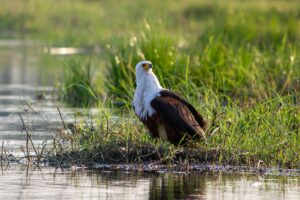 The Delta landscape changes constantly as the waters flood and then recede with the seasons. What was land becomes water, and what was a waterway becomes a floating island or a dry island if the land is elevated enough. Reeds, papyrus, and tall grasses make up these floating islands where the elephants and the crocs like to be. Hippos hang out under the islands but move to the deeper channels as the floodwaters recede. Hippos all come out of the water at night to higher dry ground and do hippo things. Buffalo, warthogs, zebra, giraffe, lion, leopard, and a half dozen species of antelope make the dry islands their home, crossing from island to island through the shallower channels. Animals here know how to swim.
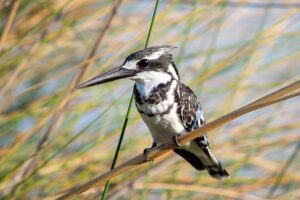
Then there are the birds. Oh yes, the birds! There are simply dozens and dozens of species, almost all of them beautiful—even the females. Standing underneath a group of trees this morning, the noise from the hornbills and starlings was almost deafening. A King Fisher was busy fishing, and numerous Bee Eaters flitted about from flowering bush to flowering bush. High above us was a Giant Eagle owl sitting next to its nest with a chick just tall enough to peer out over the edge. Hornbills are abundant. Fish Eagles sit majestically on their perches at the top of the trees, and their cries punctuate the morning crispness. Those of us who are counting now have 45 birds on the bird list. Considering that we started at zero, that’s pretty good.