We had a few days in Dhaka, Bangladesh, before we started work in Chittagong with the Asian Women’s College. 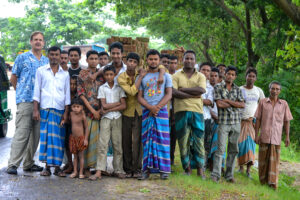 We hired a guide for the weekend. In the morning, we met our guide, Zia, who gave us our suggested itinerary for the few days we would be spending with him. He added that, of course, we could stop anywhere and take photos of whatever we wanted. The people are very, very friendly.” I remember thinking, “Yeah, right” about the photographing anybody part. It is challenging to take good people shots. Most people don’t want a camera pointed at them without their permission, and in the developing world, many want compensation when they do agree. And rightfully so. I always struggle with my desire to photograph what I see, while remaining respectful. I suspect that taking really good people photos requires that the photographer be a bit of a jerk. I think of myself as many things, but generally not a jerk. It’s always a dilemma for me each time I carry a camera. To point and click and risk making people angry, or regretting forever the shot that was missed.
From the instant we got in the van in Dhaka and headed out of the city, Kevin and I were nudging each other and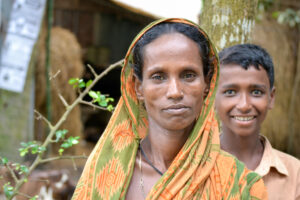 asking, “Did you see that?” This was almost always followed by, “Oh my God!” Zia would respond almost as regularly with, “Would you like us to stop to take photos?” We collectively answered, “No”. We were completely overwhelmed by what we were seeing. We needed to get our Bangladeshi legs under us first.
About two hours out of Dhaka, we couldn’t contain ourselves any longer and asked Zia to stop the van. Stepping out of the van was almost as dangerous as riding in the van. The driver assumed that, as tourists, we would step blindly out of the van into the traffic mayhem and be killed. Pretty good assumption, really. He always slid the van door open and then stood slightly in front of me with both arms out, protecting me from certain death. I came to appreciate this man very much over the next few days.
Our first stop was along a highway where villagers were tending roadside stands. As I stepped out of the van, Zia said, smiling, “You will grow a tail”. When I looked at him quizzically, he told me, “Wait and see”. There are NGO’s all over Bangladesh with foreigners from every developed country in the world attempting to alleviate the suffering here. Certainly, every village must have had some pale-skinned, blue-eyed, blond woman visit. Yet from that very first morning 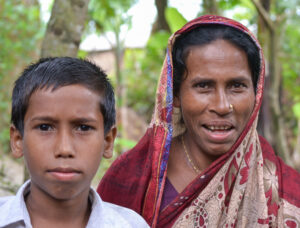 when we ventured out of the van, we drew a crowd around us each and every time. While Kevin was of some interest, it was I they were most curious about. It was as if they had never seen the likes of someone like me. I can only imagine their conversations later that day: “Did you see her drab clothing? She had nothing with any color!” Or, “She had no gold, poor woman.”
Even the poorest of women wear gold jewelry. Our “tail” would first start with a few kids and teenage boys following close behind, but soon there would be a gathering of old and young, male and female alike. Over and over again, I would turn around, and the 5 to 10 people who had followed us at the beginning had grown to 20, then 30. I can’t quite describe what it was like to have so many people gathered around, staring. Fortunately, they were, as Zia said they would be, warm and friendly. We touched hundreds of hands and smiled until our faces hurt. More than that, they all wanted their photos taken! Imagine that! As I lifted my camera, everyone would crowd into the shot. Afterwards, I would show them all the photo. Those in the photo would go get friends and relatives to have 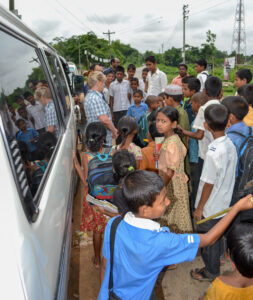 their photos taken. There was a constant tugging on my sleeve to take so-and-so’s photo. Eventually, Zia would gently shepherd us to the van with me muttering, “Just one more,” and we would drive away, waving goodbyes out the window. Next time—should there ever be one—I will bring a Polaroid camera and leave people with something.
We visited three villages during our time with Zia. We would stop the van, walk into the village, greet people, and take photos. While we will never understand what it is like to live in a village in Bangladesh, Zia provided us with a window into a world completely different from our own. That is certainly the treasure we bring home.